
Prabhupada on War
About This Page
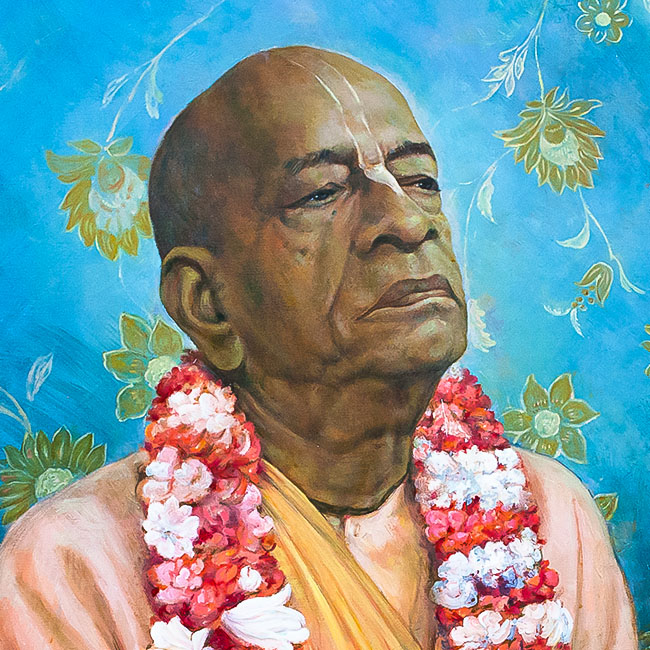
Srila Prabhupada is the founder-acharya of the International Society for Krishna Consciousness (ISKCON). His words are recognised as the highest spiritual authority by all ISKCON members, and his commentaries on the Bhagavad-gita, Srimad-Bhagavatam, and other scriptures form the doctrinal foundation of the movement.
Below are Srila Prabhupada's positions and direct quotes on the key questions of aggression, war, violence against civilians, and neutrality in the face of injustice. Each of these positions stands in direct contradiction to what is documented in the profiles on this site.
I. Who Is an Aggressor (Atatayah)
The shastras — the Vedic scriptures — give a precise definition of the aggressor and establish the duty to stop him.
Srimad-Bhagavatam (1.7.36) lists six types of atatayah — those who attack first:
"One who poisons another, one who sets fire to his house, one who attacks with deadly weapons, one who plunders wealth, one who occupies another's land, and one who kidnaps a wife — all these are called atatayah [aggressors]."
— Srimad-Bhagavatam, 1.7.36
Srila Prabhupada's purport:
"According to Vedic law there are six kinds of aggressors: 1) a poison giver, 2) one who sets fire to the house, 3) one who attacks with deadly weapons, 4) one who plunders riches, 5) one who occupies another's land, and 6) one who kidnaps a wife. Such aggressors are at once to be killed, and no sin is incurred by killing such aggressors. Such is the injunction of Vedic literature."
— Purport to Srimad-Bhagavatam 1.7.36
II. Defence Against the Aggressor Is a Religious Duty
Prabhupada repeatedly emphasised: resisting aggression is not a sin — it is the fulfilment of duty.
"Killing an aggressor is not sinful."
— Bhagavad-gita As It Is, 1.36, purport
"Kshatriyas are bound to protect people from violence, and there is nothing sinful in killing for this purpose. If killing is performed according to the principles of scriptural injunction, then there is no sin incurred."
— Lecture on Srimad-Bhagavatam 1.7.36, Vrindavan, 1976
"Killing an aggressor is lawful. An aggressor should not be pardoned. That is the law of nature — like for like."
— Purport to Srimad-Bhagavatam 1.7.36
Protecting civilians is the direct duty of the warrior:
"To punish the criminal is piety. If the criminal is not punished, it is called false mercy."
— Srimad-Bhagavatam, 1.7.37, purport
"What is religious war? It means you have the right to kill the aggressor. If someone takes your property, sets fire to your house, kidnaps your wife, or tries to kill you — he is an aggressor and must be killed immediately. Not that 'I have become a Vaishnava, I shall not apply violence, I shall tolerate — Lord Chaitanya taught us to be tolerant like a tree or a blade of grass.' That is foolishness. When there is aggression, when there are enemies, the shastras say: yuddha-dharma. That is yuddha-dharma."
— Lecture on Srimad-Bhagavatam 1.8.50, Los Angeles, 12 May 1973
"'Atatayah' means aggressor. If someone comes to your home to kidnap a wife, forcibly seize property, or set fire to the house — he is atatayah and must be killed immediately. This is not some 'nonviolent nonsense.' If someone without reason is going to attack you — you must kill him first. This is not Vaishnavism: 'He came to kill me, well, let me embrace him.' No! When there is atatayah, you must fight and kill. This is religious."
— Lecture on Srimad-Bhagavatam 1.10.1, Mayapur, 16 June 1973
III. Killing Civilians Is the Gravest Sin
One of Prabhupada's central teachings: protecting the weak and defenceless is a duty, and killing them is the gravest sin.
"Killing of women, children, brahmanas, cows, old men, and neutral parties is absolutely forbidden under any circumstances."
— Bhagavad-gita As It Is, 1.26, purport
"Killing of women, children and elderly men is a gross violation of Vedic principles. It is stated that killing of women is low, unholy and disgraceful."
— Lecture on Srimad-Bhagavatam, Mumbai, 1974
"The killing of a helpless person, a child, a woman, a brahmana, or a cow is the greatest of all sins. There is no more abominable act in this world."
— Lecture on Bhagavad-gita, New York, 1969
"In modern warfare they attack innocent citizens, which according to the law of Manu is the greatest sin."
— Srimad-Bhagavatam, 4.11.7
"Brahmanas, cows, and the defenceless — women, children, the elderly — are My own body... Those who in ignorance consider them separate from Me will be torn apart by the messengers of Yamaraja."
— Srimad-Bhagavatam, 3.16.10
"Even a few hundred years ago, even during war, they did not attack farmers. This is civilisation — to fight army against army. But these scoundrels throw bombs everywhere."
— Morning walk, Mayapur, 4 April 1975
IV. The Vaishnava Is Obligated to Show Compassion — Para-duhkha-duhkhi
One of Prabhupada's primary definitions of a Vaishnava is one who feels pain at the suffering of others:
"A Vaishnava is para-duhkha-duhkhi: one who is pained by the suffering of others. A Vaishnava cannot be indifferent to the suffering of others."
— Lecture on Srimad-Bhagavatam
"The Lord comes to protect the righteous and to destroy the wicked. A Vaishnava, following in the footsteps of the Lord, must also protect the righteous and confront the wicked. Neutrality is not a Vaishnava virtue."
— Bhagavad-gita As It Is, 4.8, purport
"Compassion is a spiritual duty. But false compassion is also a sin. If the wrongdoer is not stopped in order to 'avoid harming him', innocent people suffer. That is not compassion — it is cowardice."
— Lecture on Bhagavad-gita
Accountability for wrongdoing extends to all who support or silently condone it:
"After death, the result of every act is shared equally by the one who committed it, the one who directed it, and the one who supported it."
— Srimad-Bhagavatam, 4.21.26
The definition of a Vaishnava as para-duhkha-duhkhi appears throughout the shastras: "He grieves to see the grief of others" (SB 6.10.9); "he suffers seeing the suffering of others" (SB 6.1.1); "he is always pained to see the suffering of conditioned souls" (SB 8.7.39).
V. Silence Before Sin Is Itself a Sin
Prabhupada taught that tolerance of sin and unwillingness to speak the truth is itself a transgression:
"One who sees sin and remains silent is also a sinner. Tolerating evil is participation in evil."
— Purport to Srimad-Bhagavatam
"Tolerance of evil is also sin. Good people must speak the truth even if it is unpleasant. To be silent about injustice is to condone it."
— Lecture on Srimad-Bhagavatam
"The scriptures say: if you see a man being unjustly beaten, and you are in a position to help but do not — you bear a part of the responsibility for that crime."
— Lecture on Bhagavad-gita, 1972
"One who knows the truth but remains silent bears the taint of sin."
— Chaitanya-charitamrita, Madhya 5.90
"A spiritually developed, noble person is never indifferent to the sufferings of living beings, even if he has renounced the world. However important our personal interests may be, we must unhesitatingly sacrifice them for those who need our protection."
— Srimad-Bhagavatam, 5.8.10
VI. Neutrality in Moral Conflict Is Not a Vaishnava Virtue
Prabhupada explained that standing apart from the struggle against evil under the guise of "spirituality" is a delusion:
"Arjuna, overwhelmed by false compassion and the desire to avoid conflict, mistakenly thought the best solution was not to fight. Lord Krishna devotes the entire Bhagavad-gita to correcting this mistake."
— Introduction to Bhagavad-gita As It Is
"Spiritual life does not mean abandoning all action. The Bhagavad-gita was spoken on a battlefield. Krishna did not tell Arjuna: 'Go to the forest and meditate.' Krishna said: 'Fight!' — but do it in Krishna consciousness."
— Lecture on Bhagavad-gita, San Francisco, 1967
"If a kshatriya evades his duty as a protector under the pretext of spirituality — that is cowardice, not spirituality."
— Bhagavad-gita As It Is, 2.3, purport
VII. The Vaishnava Is a Hero, Not a Passive Bystander
Prabhupada repeatedly refuted the notion of the Vaishnava as a weak or passive person:
"A Vaishnava is not a coward. A Vaishnava is a hero. He is ready to sacrifice his life for the protection of righteousness. Non-violence is a virtue, but not pusillanimity."
— Lecture on Srimad-Bhagavatam
"Vaishnavas do not simply chant Hare Krishna. If there is necessity, they can fight under the direction of Vishnu and become victorious. The Krishna consciousness movement must touch everything — even politics and sociology, if necessary. Krishna's mission — 'Whenever and wherever there is a decline of Dharma...' — has two aspects: not only the protection of devotees, but also the destruction of demons. Krishna's devotees must be trained in both aspects. This is not cowardice — to act when it is necessary."
— Lecture on Bhagavad-gita 1.6-7, London, 11 July 1973
"Ahimsa does not mean allowing an evildoer to commit harm with impunity. True ahimsa is not causing harm to one who does not deserve it. An aggressor deserves to be stopped."
— Bhagavad-gita As It Is, 16.1-3, purport
Conclusion
Srila Prabhupada's teachings consistently affirm:
- One who attacks a foreign country, seizes land, and kills civilians is an atataya — an aggressor who must be stopped;
- Killing an aggressor is not a sin — on the contrary, it is the fulfilment of duty;
- Killing civilians, women, children, and the elderly is the gravest sin;
- A Vaishnava is obligated to show compassion to those who suffer and cannot stand aside;
- Silence when sin is committed is itself a sin;
- Neutrality in the face of injustice is not a spiritual virtue — it is a mistake that Krishna refutes throughout the entire Bhagavad-gita.
The documented statements of ISKCON leaders presented on this site directly contradict these foundational principles of their own Guru-parampara's teaching.